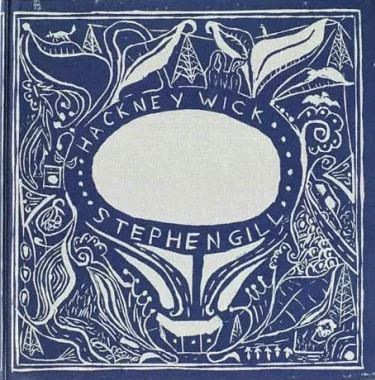
Hackney Wick
Stephen Gill
Nobody Books and Archive of Modern Conflict
English
Text by Stephen Gill
Hardcover
Edition of 1500
126 pages incl. 1 gatefold
223 x 223 mm
2005
ISBN 9780954940515
Hackney Wick sits in east London between the Grand Union Canal, the River Lea and the Eastway A106. Stephen Gill first came across the area at the end of 2002 when he was photographing the backs of advertising billboards. His first visit was on a Sunday, to the vast market that used to take place in the old greyhound/speedway stadium. At first glance, apart from a few pot plants, most of the items on sale looked like scrap – exhausted white goods, mountains of washing machines and fridges, copper wire and other metals stripped from derelict buildings, piles of old VHS videos. Stephen bought a plastic camera for 50p. It had a plastic lens and no focus or exposure controls, and he started making pictures with it at once. Over the next two years, he visited Hackney Wick again and again. The market closed in July 2003, and the remains of the old stadium were demolished weeks later as part of the preparations for the 2012 Olympic Games.
Contribution by Laure Prouvost.
(Source: https://archiveofmodernconflict.com/hackney-wick/)
About the Artist
Gill’s passion for photography was sparked by his father’s quiet influence and fuelled by an early fascination with insects, birdlife, and the tiny pond creatures he’d gather to examine under a microscope. Music, too, has long been a steady companion. Together, these early obsessions nurtured a sense of wonder, and image-making became not only a way of exploring such curiosities but a means of responding to his surroundings and to the subjects that intrigue or move him. Over time, it has become an essential form of articulation and expression.
As the years have passed, Gill’s relationship with photography has continued to evolve. While he values photography’s strengths, he remains increasingly aware of its limits, how straight descriptive photographs are often unable to convey more elusive emotions, feelings, or ideas that lie beyond the glass wall of clarity, projection, and control. He works outside those limits, developing a quiet trust in chance and what can be withheld. In reducing information, he often finds that something vital — a presence, a spirit — can remain, allowing the subject to breathe without interference.
Gill continues to explore the idea that even the most abstract or ambiguous images can carry a truth, sometimes more illuminating than a clear visual description, however factual it may appear. In a time when images flood every corner of life and certainty feels harder to hold, he chooses to relinquish much of the authorship and control, seeking instead to honour his subjects by handing much of the authorship back to them. He is often drawn to finding ways to collaborate with his subjects or to assist them to fully speak for themselves, without the images being suffocated by the medium or the maker.
https://www.stephengill.co.uk/
(Source: https://www.stephengill.co.uk/about/)
About the Publisher
Stephen founded his publishing imprint Nobody in 2005 in order to exercise maximum control over the publication process of his books. His overriding intention is to make the book the finished expression of the photographs, rather than just a shell in which to house them. Experimentation with materials, collaboration with friends and a hands-on, tactile approach to maquette making would lead, in many cases, to his finished books having an individual, unique presence. This tactile approach includes materials and techniques such as lino cut printing, letter press printing, mono prints, spray paint, rubber stamps and on occasion, entire art books are manufactured and assembled by hand in Stephen’s studio. He considers the bookmaking process to be a key though separate stage in the production of his photographic works, and he aims to make books that are conceptually consistent with their content.
https://www.nobodybooks.com/
(Source: https://www.nobodybooks.com/)
The Archive of Modern Conflict is an organisation dedicated to the collection and preservation of vernacular photographs, objects, artefacts, curiosities, and ephemera. Founded in 1991, the archive began as a collection of photographs relating to war and conflict but has since expanded its remit to become the vast and thematically diverse repository it is today. They have produced and published over thirty books, often collaborating with photographers and artists such as Stephen Gill, Cristina de Middel, Thomas Mailaender, Adam Broomberg and Oliver Chanarin, and Don McCullin.
archiveofmodernconflict.com
(Source: https://archiveofmodernconflict.com/about-us/)